
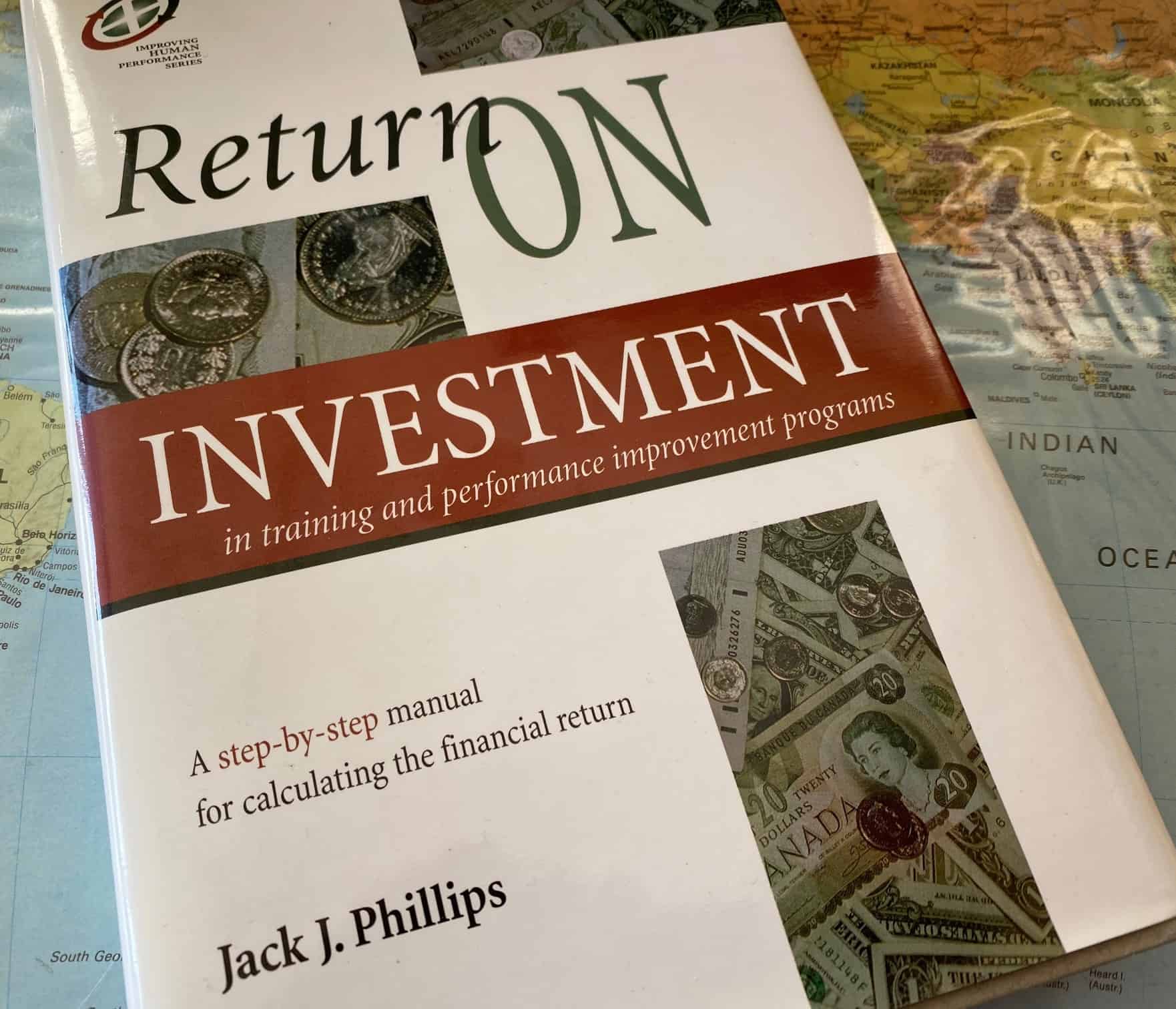
The topic of Return on Investment (RoI) in training will never go away. Despite the cliché “if you think training is expensive, try ignorance”, organisations training their staff will always look at one definite and most visible outcome of training: the cost.
That is the easy bit. Establishing the benefits of training in similar definitive and visible means may be more complex, especially as the outcomes of training will be changed behaviour that then has to translate into results, which then may have to translate into an amount of money.
Or perhaps not.
The importance of RoI was highlighted last week in an excellent session on the topic organised by the Chartered Institute of Personnel & Development (CIPD) in the Midlands. I am proud to be a volunteer with the CIPD and Chair the Coventry & Warwickshire branch. On this occasion, I was in the audience.
The input came from David Hayden, the CIPD’s Digital Learning Portfolio Manager, who highlighted how long Learning & Development professionals have relied on RoI methodology – especially from Kirkpatrick and Jack Phillips. This goes back to 1948, and whether you train or are trained you are likely to have completed some type of ‘happy sheet’ (Level 1, not everyone goes further up) giving your views of how good the training was.
What was new to me though was the work of Dr. Ina Weinbauer-Heidel, highlighted in this session. She argues, with good evidence, that the ‘happy sheet’ approach is looking at the wrong thing. What needs attention is the application of training, or transfer of learning.
To do this, use a tool with a different purpose – Net Promoter Score. I imagine you will have come across this, especially as a customer when asked by an organisation you have bought something from to rate them on a score or 1-10. A score of 8-10 is great and may lead to recommendations to others. 7 is OK. 6 or less is not really good enough.
Now use the same tool at the end of a training session, asking “How easy will it be to put this training into practice?”
I have now given this a try on some recent online sessions. The responses were a slight hesitation about giving a score, with most scores so far coming in the 7-9 range. Still, lots of opportunity to follow up.
We would all like a 10, but an 8 or 9 should be effective enough, and you can still ask whether extra assistance would be useful. A 7 would be OK, but it indicates that not all will be put into practice.
Here’s the great bit: a 6 or less means you can then ask, “what else do we need to do to put this into action?” There could be some coaching here, which will help learners evaluate what they will do rather than how they felt about the content.
I think there is a case for the benefits of the 6 or lower score – enabling that score to be followed up with coaching.
That should lead to better transfer of learning, and that will then provide the RoI your Finance Director will ask you about.
How much did you enjoy this edition of Phil’s Finance Thoughts? Score 1-10.
How likely are you to use this idea the next time you deliver, or receive, training? Score 1-10.
If you’ve read this far, go the whole way and email your scores to me at phil@philingleassociates.com. Then we can see how I can further improve my input, and your output.
Buzzwords of the Week – Enterprise Value
Definition – A measure of a company’s total value, which includes the market capitalization of a company plus short-term and long-term debt less cash on the company’s balance sheet.
The net debt (debt less cash) is included as this would need to be paid off by a buyer when taking over a company. As a result, enterprise value provides a much more accurate takeover valuation.
The EV/EBITDA metric is used as a valuation tool to compare the value of a company, debt included, to the company’s cash earnings less non-cash expenses.
Alternate View – EV has its place given the amount of debt used for corporate financing. But market capitalization is only a rough guide to worth: what someone is prepared to pay for a company. While this measure provides a veneer of science to valuation, it remains a function of human judgment, and as such is wide open to (mis)interpretation. Using with EBITDA makes things no more respectable.