
We are in recession, as you are probably aware. What we do not know is how the future will turn out, even though we now accept that our response to Coronavirus will shape what we do for some months ahead.
If recession continues, does it get worse, does it become “depression”? Classic answer: it depends. It depends not just on what economic performance we achieve, but also on your definition of depression.
Here’s a convenient one:
“A severe economic condition combining oversupply, increasing unemployment, rising stock levels, disinflation and a general sustained slowdown in business” Lamont’s Financial Glossary.
In the UK, and many areas of the world, there is huge evidence of overcapacity, although having huge numbers of people not going to work in offices actually brings down supply a little. We have increasing unemployment, sadly, alongside a general sustained slowdown. Some sectors it is more than a “slowdown”.
We do not have disinflation – or deflation. That is because governments around the world are printing money, for example to pay part salaries to workers not going to work, or furloughed. The costs of Covid treatment through health services does not come cheap either. The latest UK inflation figure hints at inflation at 0.5%.
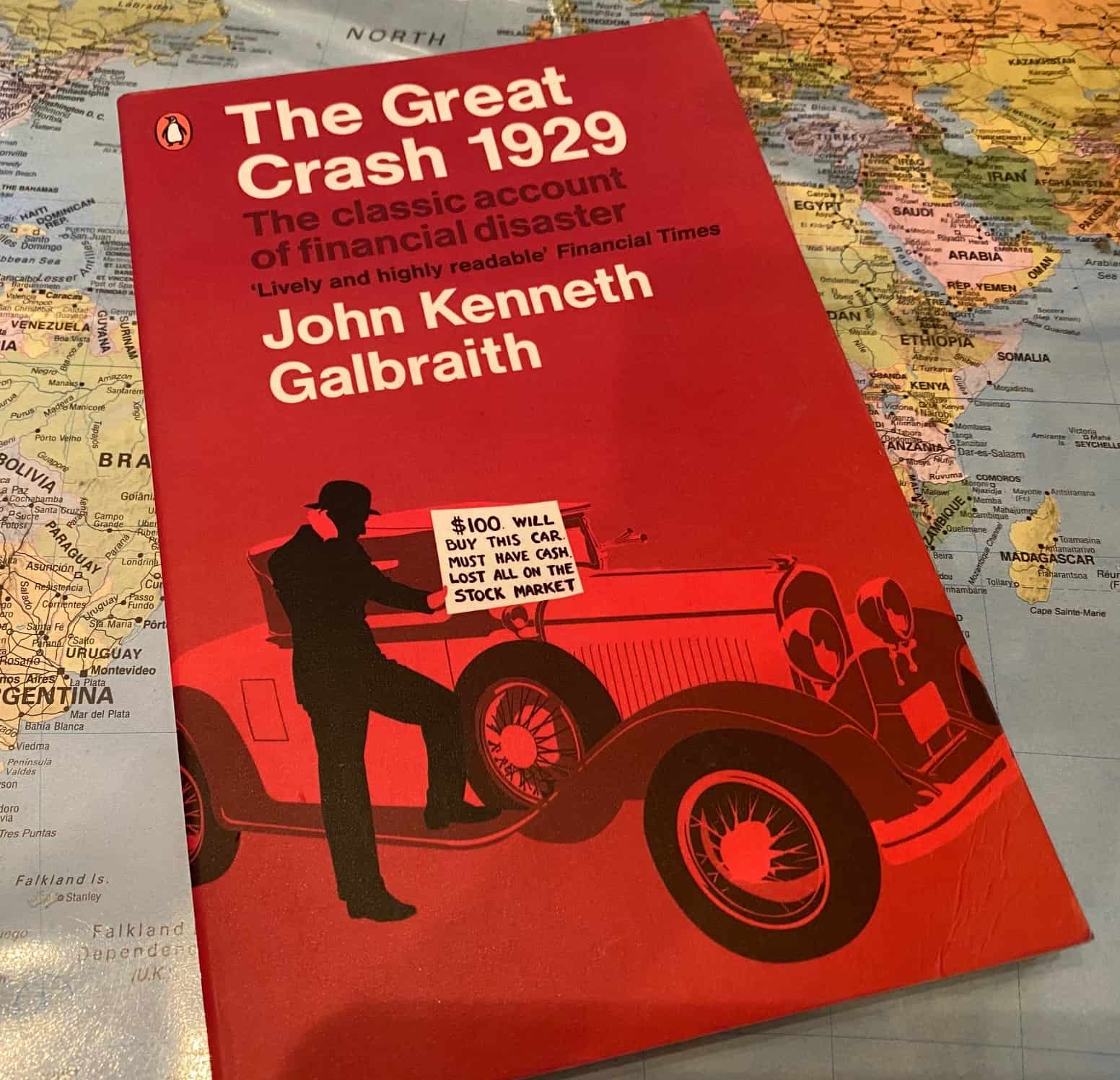
J K Galbraith’s classic book on the 1929 crash – which had implications way beyond Wall Street – is instructive in its analysis of government action, and especially inaction.
Which is probably why the economic outlook is (probably) not for a depression. In short, governments have learned some things from previous crises – most recently the financial crisis 2007-2009.
The Federal Reserve Bank of San Francisco also recycles an economist’s joke:
When your neighbour loses their job, it’s a recession.
When you lose your job, that’s a depression!
…which shows what economists know about humour. If you or someone you know is losing their job, a feeling of depression may come with it. Undeservedly.
Which is another reason why those of us enjoying good mental health need to get working in an innovative fashion to contribute to business growth in some way, even if the economic backdrop may not encourage it.
It is not just governments who must take action to avoid economic uncertainty.
https://www.frbsf.org/education/publications/doctor-econ/2007/february/recession-depression-difference/
Buzzwords of the Week – Variable Costs
Definition – Costs such as raw materials, that change depending on the level of production. Need a tonne of steel? Start with 1.2 tonnes of Iron Ore. 2 tonnes needs 2.4 tonnes, and so on. Also known as cost of sales, a more retail orientated slant – in 2020 a 30% increase in supermarket sales meant they had to buy in 30% more stock.
Alternate View – The importance of this depends on industry sector. For high volume manufacture, wholesaling, and retailing, this is vital, and especially important when calculating marginal additional business (where the fixed costs have been covered). But our developed economies tend to run on service sector and technology where variable cost is irrelevant – graphic designers have not cost of sales. And even manufacturers have a huge proportion of fixed costs, or overheads – the costs which really demand attention.
Online Learning – my first online programme – How to Read Financial Statements – is now available. This is a series of 7 online lessons:
1. How finance fits with Strategy
2. The Language of finance
3. Owning & Owing – using the Balance Sheet
4. Measuring & Managing Profit
5. Measuring & Managing Liquidity
6. Budgets, what, why & how
7. The most important part of all
Each lasts between 20 & 40 minutes and includes the slides and videos to help you understand what good looks like in financial terms. There is a special offer price this week of just $49, and is available now at https://app.mastermind.com/masterminds/8443