

Two contrasting experiences with cars:
- I finished my 2 months trial with an all-electric Vauxhall Corsa, courtesy of Coventry City’s Council’s Electric Fleet First Scheme
- I had 2 glorious days at the Goodwood Festival of Speed: watching cars (and motorcycles!) drive up the Duke of Richmond’s driveway at speeds not allowed on the road.
This is not an accurate consumer comparison, or even an introduction to a ‘Top Gear’ challenge, but below is a comparison of my electric experience and one of the more expensive cars I saw at Goodwood, The Bugatti Chiron Pur Sport.
| Vauxhall e Corsa | Bugatti Chiron Pur Sport | |
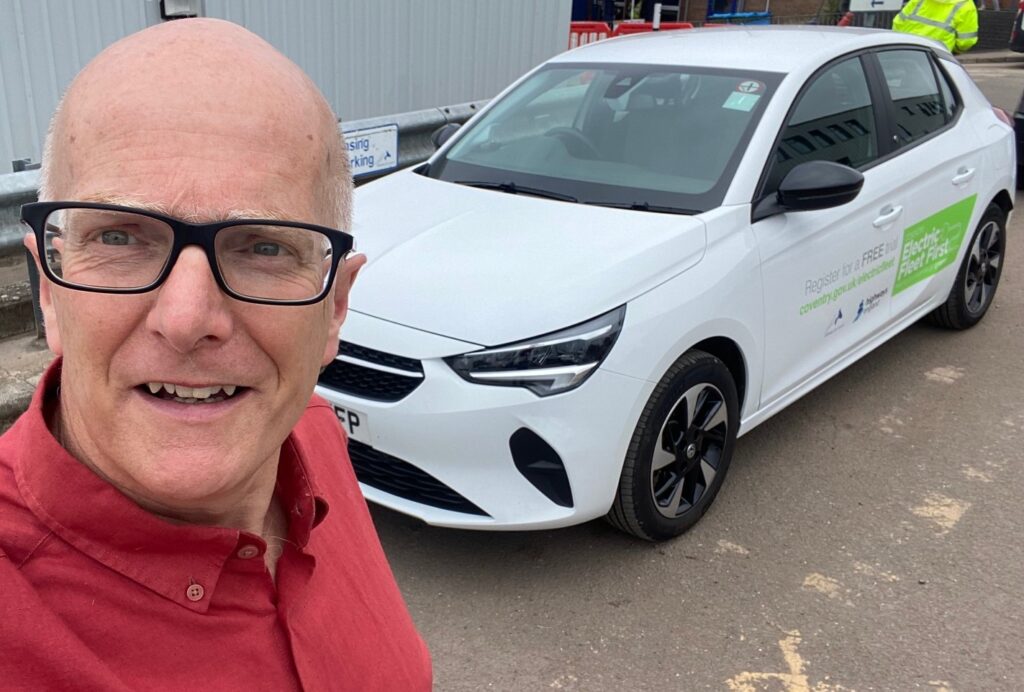 |  | |
| Price | c. £30k | c. £3.4m |
| Fuel | Electricity, maybe comes from wind | Petrol |
| Driving experience | Really very pleasant, quiet & refined | (I imagine) makes you feel a million dollars, you’d be scared driving it down a UK country road |
| Running costs | Insurance £27/month: fuel costs I have no idea – you plug it in. | Eye watering. If you can afford to buy it – do you care? |
| Environmental impact | It’s green! No fumes, no CO2! | More CO2 in building it that it will burn: it will only be driven occasionally. |
| Convenience | OK most of the time: just don’t drive a long way on the motorway. Only go where there’s a charger – even then, check it is working. | Less luggage space, awkward to get into & out of, but driving environment is automotive Sistine Chapel |
| Purpose | Transport | Work of art/status symbol |
| Do I like it ? | It got me places | Admired the engineering, concept, and look. |
| Would I buy it? | No | No |
My conclusions? Neither of these cars are what they claim to be.
The Vauxhall, like many cars, is marketed as the answer to every motoring need, and especially claims about its range are highlighted. But just like the claims about petrol fuel consumption, the reality is worse. The range it told me was rarely what was actually delivered.
The Bugatti ( though I have yet to drive it) is designed to grab attention, automotive theatre if you like. As long as you enjoy being looked at, you will enjoy the car. Some of that attention could be unwanted.
The customers for these vehicles are also different. One will be purchased mainly by fleet buyers who value reliable, quiet and (allegedly) low-cost transport.
The other by wealthy individuals with an ego.
One is bought by the head, other by the heart.
Yet here lies the big learning point this week.
People buy what they want, and frequently find a way of justifying the purchase.
The Vauxhall appeals also to the heart, but in a different way – its ‘green’ claims help people feel good about the purchase, and some of the numbers make rationalisation easy.
There is no rational case for the Bugatti.
In your business, people are also buying with their heart, maybe rationalising with their head.
What are you really selling?
More on Electric Fleet first: https://www.coventry.gov.uk/info/68/pollution/171/air_quality/7
Buzzwords of the Week – Accounts Payable
Definition – Amounts due to vendors or suppliers for goods or services received that have not yet been paid for. The sum of all outstanding amounts owed to vendors is shown as the accounts payable balance on the company’s balance sheet. Also known as Creditors.
Formula:
Accounts Payable x 365 = Average* days to pay
Cost of Sales
*Rough average – improve it by using average AP & CoS.
Alternate View – Pay your suppliers as late as you can get away with. That is one philosophy. At least this provides a method of measurement. But the bigger the number the more this says about how you operate – do you want to be seen like a large supermarket which keeps its suppliers waiting? Better to view this alongside your Accounts Receivable to get an idea of how quickly the cash flows in and out of business – then take your view about what this number says about its approach to business relationships.
Coming Up…
Online Learning – my online finance programme – How to Read Financial Statements. This is a series of 7 online lessons:
- How finance fits with Strategy
- The Language of finance
- Owning & Owing – using the Balance Sheet
- Measuring & Managing Profit
- Measuring & Managing Liquidity
- Budgets, what, why & how
- The most important part of all
Each last between 20 & 40 minutes and includes the slides and videos to help you understand what good looks like in financial terms.
For more details and to sign up now: https://mailchi.mp/92ada0829df3/htrfs-v2