

Do you need a coach – or a mentor?
The differences between coaching and mentoring have triggered lengthy discussions for as long as I can remember. This week I looked at both elements in my role as a coach, as a mentor, and on a development event with CIPD Coventry & Warwickshire.
The event was led by the excellent Karen Griffin from Space 2 Be, who highlighted the differences – and indeed similarities – between coaching & mentoring. Very briefly – coaching less formal and focussed, mentoring more directive and advice focussed.
Karen’s useful slide tells you more:
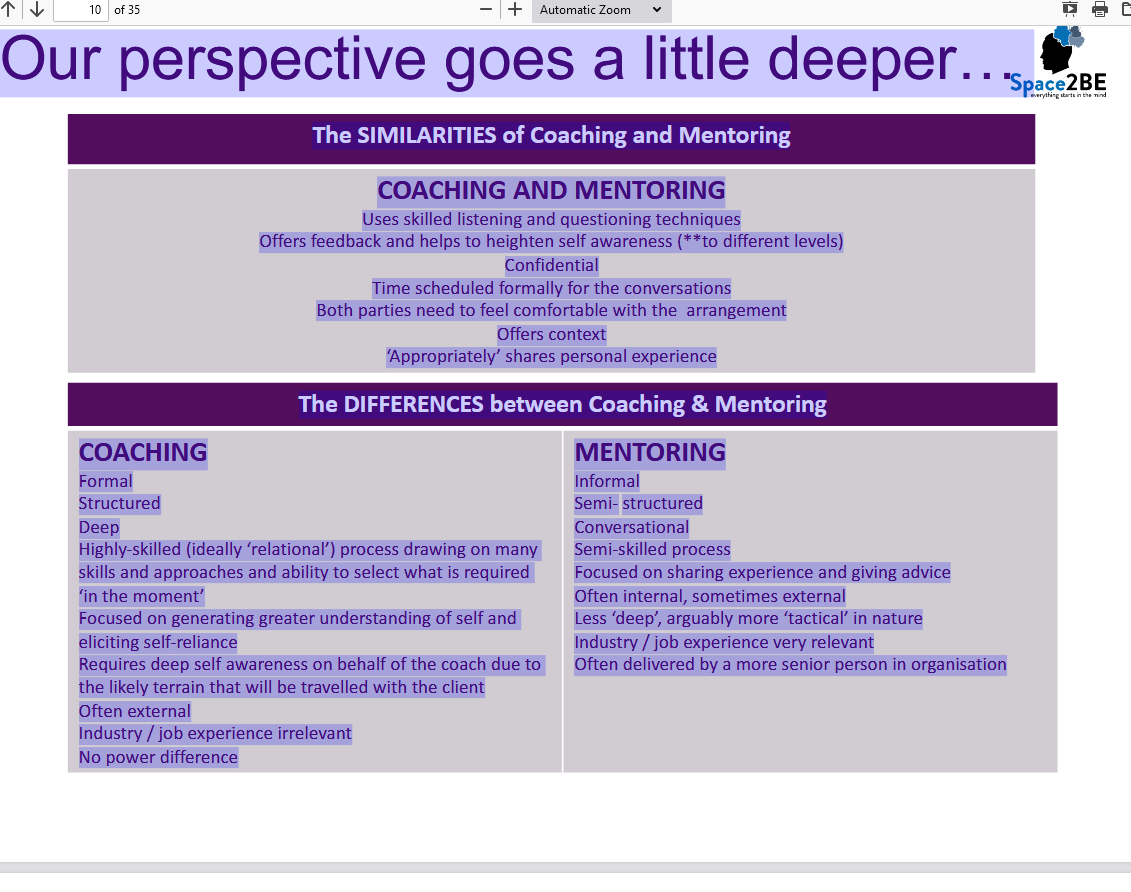
I have been exploring this in practice, in my work with start up businesses for Reset Restart, and my mentoring with the CIPD scheme. Karen’s definitions are useful to keep in mind, but in fast moving discussions I find the boundaries are less clear.
A few years back I was asked to coach a Finance Director. Super gentleman, even if he didn’t have a cash flow forecast – at least at the start. I vividly recall one of my ‘coaching’ sessions, which I started – as you may imagine – with a suitable open question about how he was progressing. The discussion lasted a couple of hours, during which we covered their future expansion plans, seeking finance from the bank, the board discussions and meeting agenda, information he provided to other directors. During all this I did not just coach:
- I showed him how some additional ratios could help show performance (training)
- Asked him what he could do (coaching)
- In response to his comment “ I’m not sure about this: Phil, if you were me what would you do?” I offered some advice (mentoring)
- He asked if I would write the business case for the bank finance (consultancy)
- The CEO also popped in, with the Sales Director. I helped them talk through one issue (facilitation)
Some of my coaching on Reset Restart has strayed into mentoring when we use the definitions above. My mentoring also uses coaching some of the time.
Why is this important? One of the aspects Karen brought out is that ultimately it is the person we are helping who determines what type of response is required. We may need to switch between modes, much as did with the Finance Director. Her suggestion was to maintain an awareness of mode, and signpost when you are switching: “as your coach I would ask…. But as your mentor I might say…”
With your team you may find being a coach, or a mentor, is not always enough. Remember it is not necessarily which mode you offer; it is ensuring the person you are ‘coaching’ (or mentoring/training/helping problem solve…) is in the best place to act as a result of your interventions.
By the way – the finance director I was coaching. They got the bank finance for expansion, built larger premises, and have since had the opportunity to take over another business at a new site. It has not always gone to plan, but overall they have achieved what they were dreaming of.
For your team – what do they need? And for your development, what is it you need right now?
Buzzwords of the Week – Lease
Definition – ‘a contract, or part of a contract, that conveys the right to use an asset (the underlying asset) for a period of time in exchange for consideration’.(IFRS 16)
Alternate View – The big advantage of leasing is the ability to use an asset – often an expensive car, aeroplane, ship or piece of machinery – without the big capital outlay, because you pay over time or usage. IFRS 16 was significant because leases and related equipment must now feature in company balance sheets. Better than owning outright? It depends: do the numbers, including any taxation benefits.
Coming Up…
Online Learning – my online finance programme – How to Read Financial Statements. This is a series of 7 online lessons:
- How finance fits with Strategy
- The Language of finance
- Owning & Owing – using the Balance Sheet
- Measuring & Managing Profit
- Measuring & Managing Liquidity
- Budgets, what, why & how
- The most important part of all
Each last between 20 & 40 minutes and includes the slides and videos to help you understand what good looks like in financial terms. For more details and to sign up now: https://mailchi.mp/92ada0829df3/htrfs-v2