
The first thing you do in business
At the start of my MBA in 2000 at Cranfield University, I recall each class beginning with an introduction from the lecturer stating how important each subject was. How statistics meant you could understand data, how organisational behiour would help you understand people, how project management would get things done on time. It seemed each lecturer had the most important topic.
Nearly 22 years later I know who was telling the truth – Lynette Ryals, at the time our Marketing lecturer & Head of programme (now Vice Chair to Assembly there).
Having heard many years ago from the late Richard Denny that ‘nothing happens in business until the sale is made’ I was already a believer of the importance of sales – this was also reinforced on my MBA studies on entrepreneurship. But what leads to a sale? Marketing.
At times marketing gets a bad press: think of dubious advertising claims and the selling of ‘snake oil’ products, and much marketing activity can take on an air of insincerity and lies. There is plenty of evidence too – have a look at the weekly reports from the UK’s Advertising Standards Authority, who state “our ambition is to make every UK ad a responsible ad.” A review of their latest rulings shows how frequently there are shortfalls. (Easy to look at these and conclude there is a problem: in the context of the volume of advertising, breaches of the ASA code are rare)
Of course, marketing is not advertising, and advertising is definitely not the whole of marketing. What is? Try these definitions:
- “Marketing is the activity, set of institutions, and processes for creating, communicating, delivering, and exchanging offerings that have value for customers, clients, partners, and society at large.” (Approved 2017) American Marketing Association
- “Marketing is the management process responsible for identifying, anticipating and satisfying customer requirements profitably.” Chartered Institute of Marketing
- “Marketing is the generous act of helping someone solve a problem. Their problem. Marketing helps others become who they seek to become”. Seth Godin makes a distinction between bad marketing and good marketing.
(If you don’t like these definitions, others are available. Just like your product and your competitors’ products…)
The first two definitions are, frankly, a bit ‘dry’, unexciting, and dull. Not marketing at all then.
Seth Godin’s definition to me sounds better and more positive, even if bordering on the evangelical.
I move to this one as I feel it represents so much of how we live today. In the UK, most of our basic needs are catered for, what we focus on is buying what we desire, not just what we need to get by. Even simple product choices are about what we seek to become. Why should I read the news on Google when I can pay several hundred pounds each year to read the Financial Times?
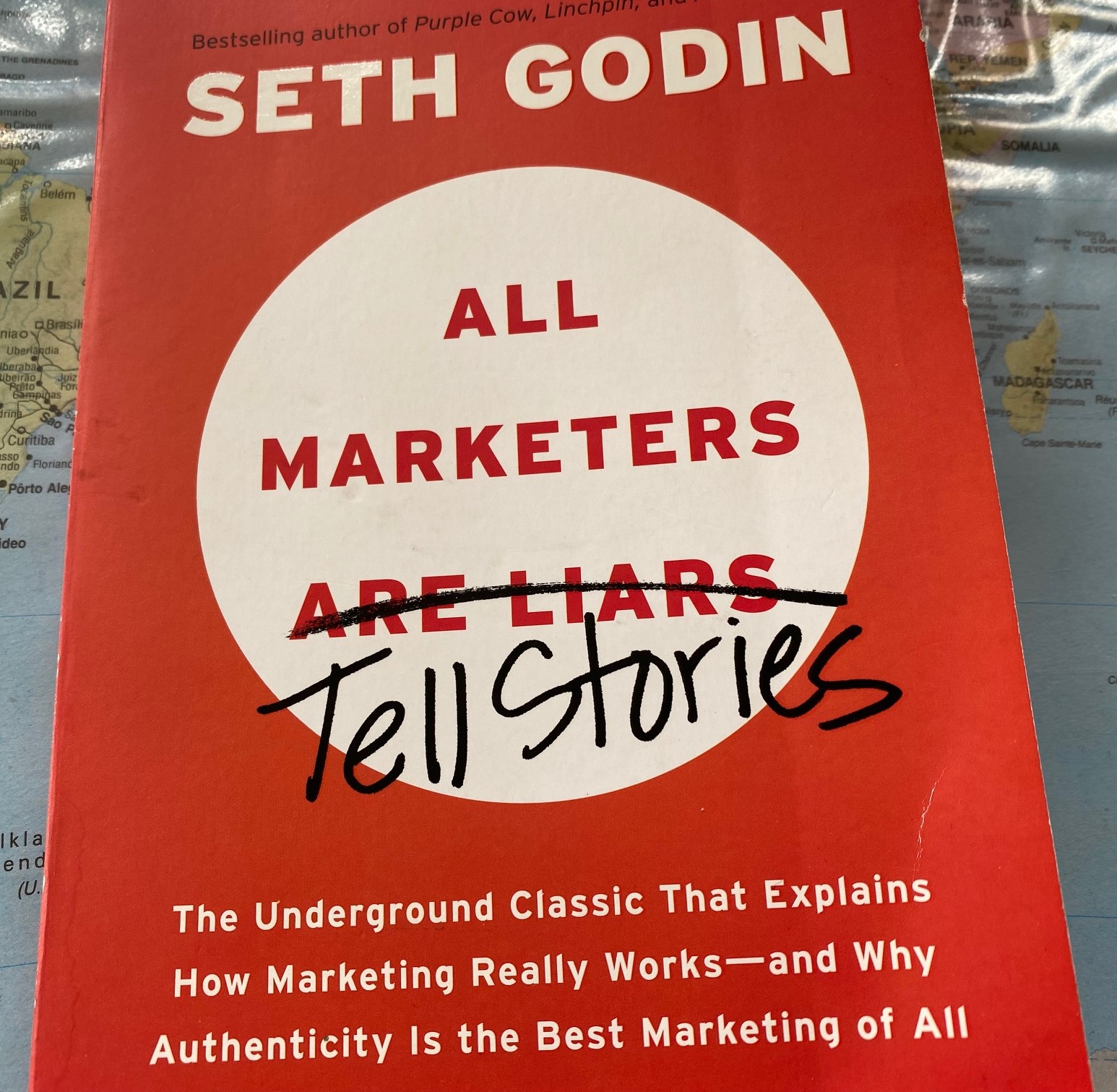
I enjoyed Godin’s book about marketers telling lies…well stories. Every story is a marketing opportunity. Look at what is happening right now in the car market (in the US and UK, plus much of Europe) – new cars are in short supply. Yet the marketing has not decreased because there are fewer products to sell: the story has just changed, so the focus is on second hand cars . Prices have increased to match demand and supply – while still helping people become what they to become. Even old cars – sorry, classic cars – are reaching record prices. My visit to the Kineton Classic Car meeting last week included a 1960s Aston Martin valued at over a quarter of a million pounds.

While working with start-up businesses (you will see below the Inglued Start Up Academy begins next week) I often find myself saying “You have two jobs: the second is doing what you do – the first is finding someone who will pay you to do it”
That is why marketing is number 1.
What your story?
https://www.bbc.co.uk/news/business-58150025 on the state of the UK car market.
Buzzword of the Week – Profitability
Definition – A business’s ability to produce a return on an investment based on its resources in comparison with an alternative investment. Profitability is related to profit – but while profit is an absolute amount, profitability is a relative one. It is the metric used to determine the company’s profit in relation to the size of the business. Although a company can show a profit, this may not necessarily mean that the company is profitable.
Alternate View – Split this into two words: profit and ability. The important bit is the ability, making the definition of it as a comparative term is more useful. It is not enough to make a profit, you must be able – and to prove that measure it as a return on capital, not a margin or just an amount of money.