
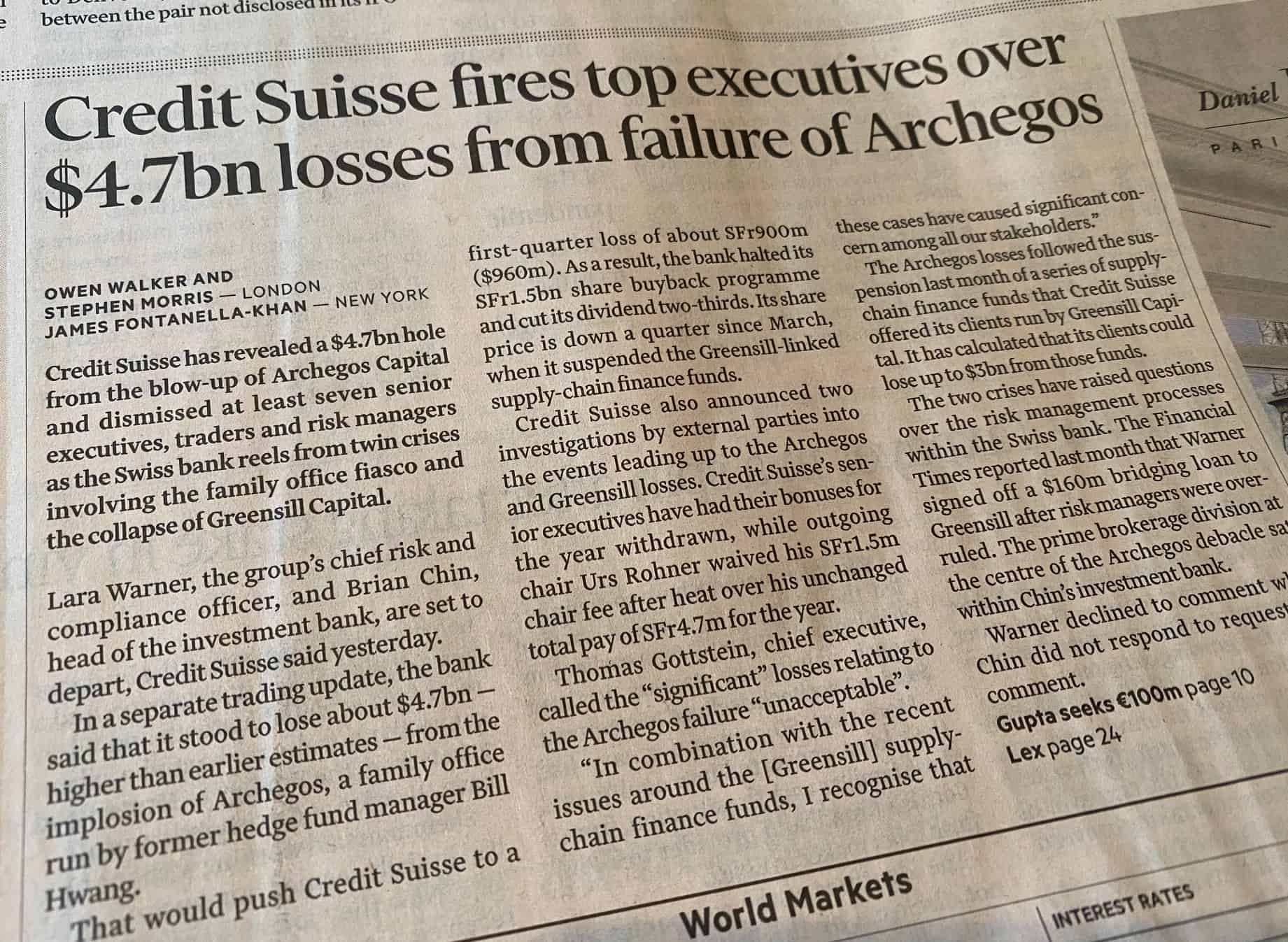
The wall on which I would have liked to have been a fly this week is that of Credit Suisse’s boardroom – or their presumably virtual equivalent. They have endured losses following the untangling of the Archegos Capital hedge fund, which has quickly followed calling in their support to Greensill Capital, a client of theirs, now in administration (with consequent issues for Liberty Steel in the UK and Sanjeev Gupta’s GFG Alliance internationally). Credit Suisse have ‘let go’ some Executives, including their chief Risk & Compliance Officer.
Go back a couple of years and they were involved in allegedly spying on their own board members.
My curiosity about their issues stems from their previous long term and relatively private success: they remain one of Europe’s largest banks. When things go wrong, the board must do three things: take responsibility, accountability, and action.
It is when a board has to do these things that effect of their previous decision making becomes apparent. Every decision a board (or committee, or team) makes will mostly seem like the right one at the time: but over time it may prove not to be, and cause me – and others – to ask, “what were they thinking?”
The job of the company board is to set the strategy, and generally to let the management take care of the tactics. The strategy involves looking ahead to anticipate risks and opportunities. There are a range of tools and models to help – PESTLE, Five Forces, & SWOT Analysis for example. The important things with these are not the outcomes from using these tools but asking “So What?” about the outcomes – and deciding where the strategy needs to meet the tactics.
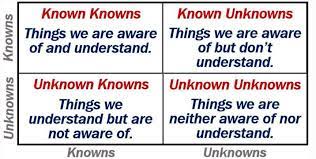
Which brings me to the time honoured Known/Unknown matrix.
Think about the issues your business has faced over the past year: response to Covid 19, cyber security, and in the UK – Brexit. Your can add your other issues to this list.
Covid 19 started as an Unknown/Unknown, but soon shifted to a Known/Unknown.
What about the other issues on your list – where were they?
Credit Suisse is hardly alone in having ‘issues’ right now. Recent years have a number of high-profile business problems and collapses, the responsibility for which should always end up with the board of Directors.
Consider these:
• Carillion
• Greensill Capital
• Debenhams
• Patisserie Valerie
• Arcadia
• Goals Soccer Centres
• Wirecard
Not a complete list, but if you like Googling news try these names if you do not already know the stories.
Their issues have been various: but there is a common thread. Their Directors made decisions in good faith but either did not see what was coming or did not understand the impact.
The art of corporate decision making is to expand the Known/Known box as wide and high as possible, while looking out for the Unknowns/Unknowns. The latter includes the possibility that one, or some, of your fellow directors are dishonest and committing fraud.
Yet corporate decision making ‘art’ is why you have a board of Directors: leaving everything to one person, whether dictator or dominant CEO (some see these as the same thing) means the Known/Known box size remains the same. Decisions made in teams/boards/together will always prove more effective. Not necessarily always right, but you will not know that at the time.
Just ask Credit Suisse.
Better still, ask your Directors.
https://www.businessinsider.com/credit-suisse-ceo-tidjane-thiam-steps-down-after-spying-scandal-2020-2?r=US&IR=T for the old ‘spying’ news from last year
https://www.ft.com/content/c10d0b81-f2ef-48c3-8e9c-17419f4af21b from yesterday: but watch todays business news too: you never know…
Buzzwords of the Week – Hedging
Definition – Think of it as a form of insurance. When people hedge, they insure themselves against a negative event’s impact on their finances. This doesn’t prevent negative events from happening – but if a negative event does happen and you’re properly hedged, the financial impact is reduced.
In practice, hedging occurs almost everywhere. For example, if you buy house insurance, you are hedging yourself against fires, break-ins, or other domestic disasters.
Portfolio managers, investors, and businesses use hedging techniques to reduce their exposure to various risks. Hedging against investment risk means strategically using financial instruments like derivatives to offset the risk of adverse price movements. Simply: investors hedge one investment by making a trade in another.
Technically, to hedge requires you to make offsetting trades in securities with negative correlations. Of course, you still have to pay for this type of insurance one way or another.
Alternate View – It is financial insurance. In practice it is made to sound way more complicated as the tools are full of jargon: put options, call options, swaps, futures to name a few. Whatever financial risk you are taking, you will find someone to insure – hedge – it for you, at a price. It is then up to you to decide (sometimes very quickly) whether you think covering the risk is worth the price.
Hedge funds make their money (and sometimes lose it) by using financial tools to leverage returns (or if they get it wrong – losses).